
Dynamic energy contracts for businesses: maximum flexibility and cost optimisation
In an energy market that is moving increasingly fast, businesses are facing a growing need to manage their energy consumption more efficiently and keep tighter control over costs. A dynamic energy contract offers exactly that: it links the electricity tariff directly to the quarter-hourly prices on the wholesale market. This enables companies to benefit from low market prices and strategically align their consumption with the times when energy is most cost-effective.
What is a dynamic energy contract for businesses?
With a dynamic energy contract, the electricity price changes every 15 minutes, based on the market price on the day-ahead market (EPEX Spot). This means:
your business pays the exact current market price at that moment
no risk premium charged by suppliers in fixed or variable contracts
maximum transparency in price formation
For businesses with a smart meter, this provides a powerful way to control and actively optimise energy costs.
How are dynamic quarter-hourly prices structured?
The total business price consists of:
1. Spot price (EPEX Spot)
The market price per quarter hour, based on supply and demand.
2. Supplier margin
A limited service fee for administration, service delivery and risk management.
3. Grid costs
Transmission and distribution tariffs via Elia and Fluvius.
4. Levies & contributions
Statutory contributions for, among other things, green energy and energy policy.
5. VAT for professional consumers
Standard VAT arrangement as applicable to businesses.
2026: Transition to quarter-hourly pricing
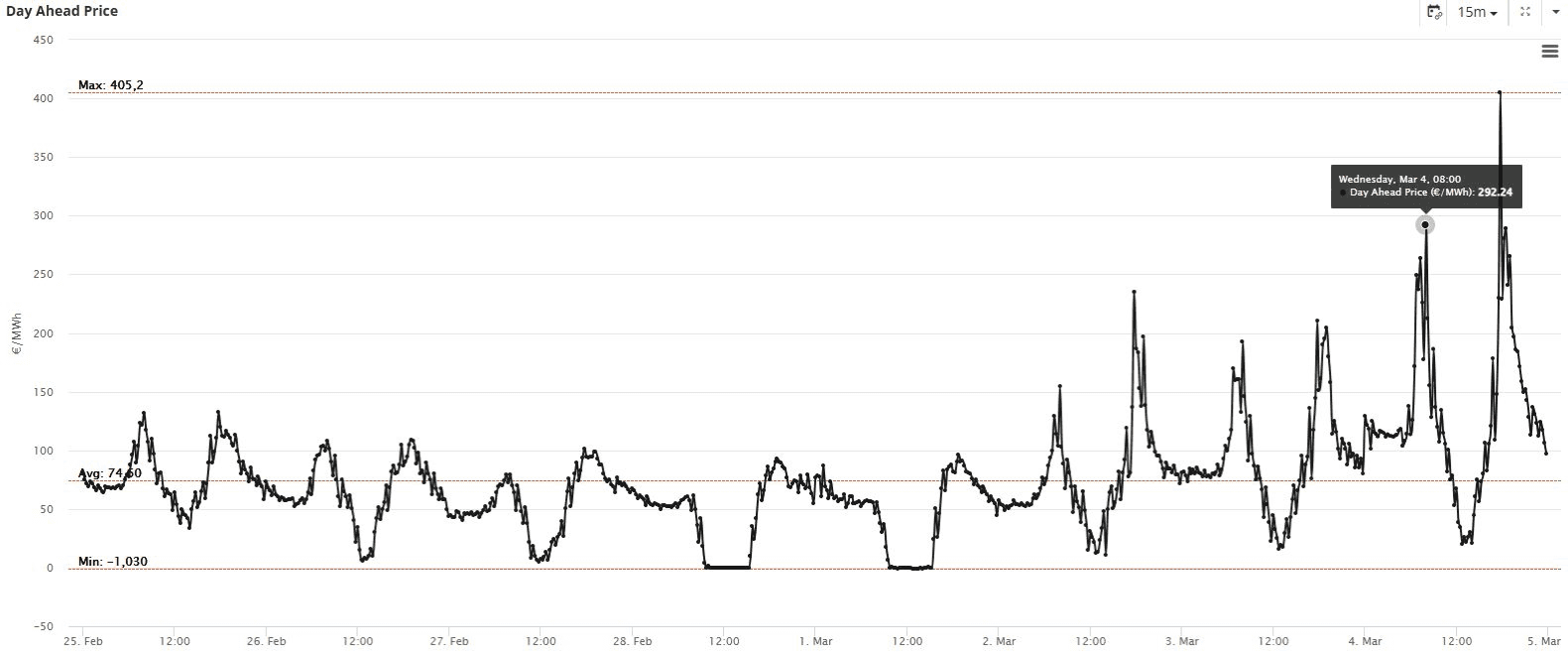
From October 2025, electricity prices on the European market will be traded as standard per quarter hour. For businesses, this means:
even more precise price signals
more opportunities for strategic control
greater variation between low-cost and high-cost moments
For companies that can deploy flexibility — such as in production processes, charging infrastructure, cooling installations or energy storage — this opens up new opportunities for structural savings.
Negative electricity prices: an advantage for energy-intensive businesses
When production exceeds consumption, market prices can become negative. This creates opportunities for:
businesses with flexible production planning
businesses with charging infrastructure for electric vehicles
companies with battery storage
cooling and manufacturing businesses that can schedule processes during the lowest tariffs
Negative prices are no longer an exception, and businesses that respond to this achieve significant cost reductions.
Maximum gains: dynamic contract + industrial battery + EMS
For businesses, the greatest added value lies not only in the dynamic contract itself, but in combination with:
✓ an industrial battery (BESS)
✓ an energy management system (EMS)
✓ potentially your own solar energy or charging infrastructure
With such a system, a business can:
purchase energy during the cheapest quarter hours
use battery capacity during expensive periods
drastically reduce peak demand
reduce capacity tariffs
charge an electric fleet at lower cost
make smarter use of solar energy
significantly reduce grid dependency
An EMS fully automates this: it monitors prices, consumption and production, and controls the optimal energy flow at all times.
Benefits for the B2B market
✓ Lower energy costs
Smart control reduces the purchase of expensive peak electricity.
✓ Higher operational efficiency
Processes can be automatically aligned with the most cost-effective quarter hours.
✓ Support for electrification
For businesses with EV fleets, charging points and electric logistics, dynamic energy delivers direct cost savings.
✓ Future-proof energy management
Dynamic contracts fit perfectly within a business strategy focused on sustainability and digitalisation.
Conclusion: a strategic choice for modern businesses
For companies that:
operate in an energy-intensive way
have process flexibility
invest in charging infrastructure
use solar panels or battery storage
want to reduce costs and become more sustainable
… a dynamic energy contract is the solution for the future.
It offers maximum market transparency, strong cost advantages and an optimal foundation for modern, smart energy management.
Article News/Blog 6:
Negative electricity prices: what does it mean and how can your business respond?
Negative electricity prices are appearing increasingly often in Belgium. For companies that manage their energy intelligently, these market conditions offer interesting opportunities. Below you will find a differently structured and fully reworked explanation of how these prices arise and how businesses can benefit from them.
Why negative prices arise
When more renewable generation is available than the grid needs at that moment, the pricing mechanism comes under pressure. In particular:
strong wind generation during night-time hours,
high solar yields on clear days,
periods with lower industrial activity, such as weekends and public holidays,
cause supply to exceed demand.
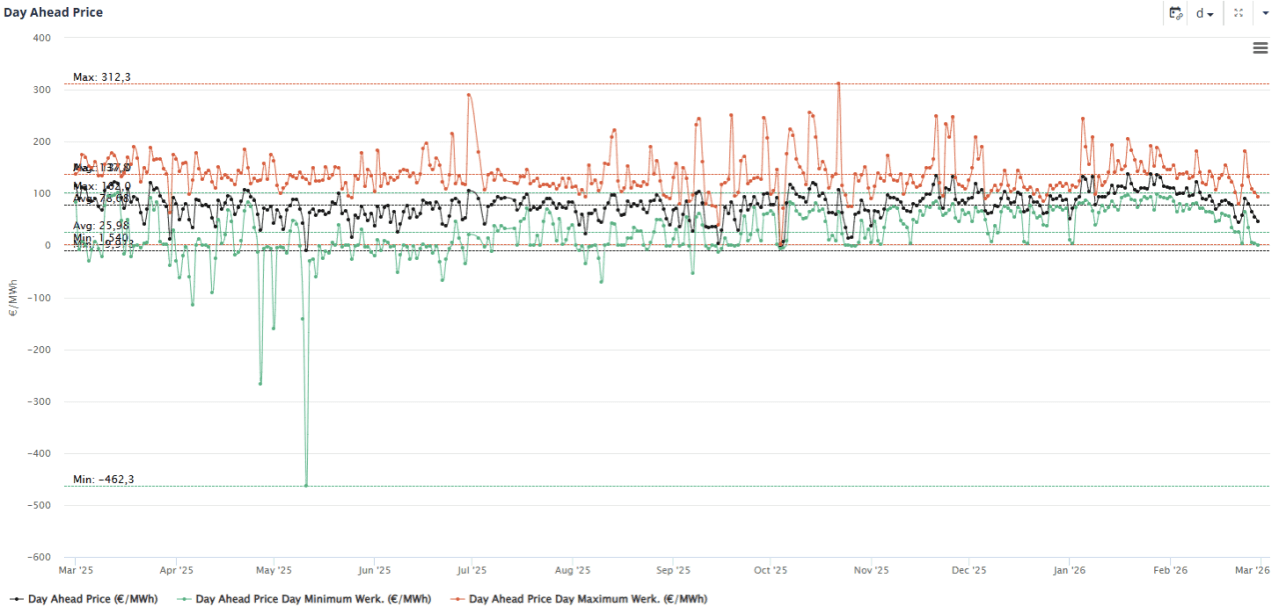
On the day-ahead market, the price can then fall below zero, as producers are willing to pay to offload electricity.
Why businesses do not receive a ‘negative invoice’
Despite negative market prices, energy invoices generally remain positive. This is because the total cost consists not only of the EPEX price, but also of:
grid fees from Fluvius and Elia,
levies and statutory contributions,
energy supplier costs,
VAT.
The negative component does reduce the total invoice, but it almost never offsets all additional tariff-related costs. Only businesses billed hourly via a dynamic contract experience the full price fluctuations.
When negative prices occur most often
The moments when the electricity price drops below zero depend strongly on the season:
In winter
Mainly at night due to high wind generation.
In summer
Mainly in the late morning and early afternoon, when solar panels deliver maximum output and demand remains low.
Why negative prices are becoming more frequent
Flanders is investing heavily in renewable energy. The number of solar installations and wind turbines is growing faster than the flexibility of our consumption. As large-scale storage capacity is still limited, energy surpluses increasingly arise, driving market prices sharply down.
The year 2025 is a clear example: well before summer, the threshold of 400 hours of negative prices had already been exceeded, and on 11 May 2025 a new low of –0.462 €/kWh was reached.
How your business can benefit from negative market prices
To take advantage of negative prices, flexibility is key. Below is a new sequence and wording of the options.
1. Smart energy control via an EMS
An energy management system is at the core of every flexible energy policy. An EMS such as our Maniac can automatically respond to price signals by:
shifting processes to cheaper hours,
charging battery systems when prices fall,
activating HVAC installations in advance,
optimising charging times for electric vehicles,
temporarily curtailing solar panels when feed-in causes costs.
This aligns energy consumption with the most cost-effective moments.
2. Battery systems for strategic energy storage
An industrial or commercial battery system allows cheaply priced or negatively priced electricity to be used later. This delivers:
substantial savings during expensive peak hours,
a more stable offtake profile,
less dependence on price fluctuations.
This process is known as price arbitrage.
3. Optimising your own solar energy
For businesses with PV installations and a dynamic contract, negative prices can even be a disadvantage when solar energy is fed into the grid. This is why it becomes important to:
increase self-consumption during production peaks,
use battery systems as a buffer,
apply curtailment when feed-in becomes financially unfavourable.
4. Choosing a dynamic energy contract
A dynamic contract is essential to benefit effectively from negative prices. With this, businesses can:
shift energy-intensive activities to cheaper hours,
optimise charging strategies,
schedule production processes flexibly.
Fixed and traditional variable contracts offer hardly any of these opportunities.